
Wednesday, June 24, 2015
An Unsupervised Approach for Comparing Styles of Illustrations

Takahiko Furuya, Shigeru Kuriyama and Ryutarou Ohbuchi
In creating web pages, books, or presentation slides, consistent use of tasteful visual style(s) is quite important. In this paper, we consider the problem of style-based comparison and retrieval of illustrations. In their pioneering work, Garces et al. [2] proposed an algorithm for comparing illustrative style. The algorithm uses supervised learning that relied on stylistic labels present in a training dataset. In reality, obtaining such labels is quite difficult. In this paper, we propose an unsupervised approach to achieve accurate and efficient stylistic comparison among illustrations. The proposed algorithm combines heterogeneous local visual features extracted densely. These features are aggregated into a feature vector per illustration prior to be treated with distance metric learning based on unsupervised dimension reduction for saliency and compactness. Experimental evaluation of the proposed method by using multiple benchmark datasets indicates that the proposed method outperforms existing approaches.

http://www.kki.yamanashi.ac.jp/~ohbuchi/online_pubs/CBMI_2015_Style_Furuya_Kuriyama/CBMI2015_web.pdf
Beyond Vanilla Visual Retrieval
The presentation from professor Jiri Matas @ CBMI 2015
The talk will start with a brief overview of the state of the art in visual retrieval of specific objects. The core steps of the standard pipeline will be introduced and recent development improving both precision and recall as well as the memory footprint will be reviewed. Going off the beaten track, I will present a visual retrieval method applicable in conditions when the query and reference images differ significantly in one or more properties like illumination (day, night), the sensor (visible, infrared) , viewpoint, appearance (winter, summer), time of acquisition (historical, current) or the medium (clear, hazy, smoky). In the final part, I will argue that in image-based retrieval it might be often more interesting to look for most *dissimilar* images of the same scene rather than the most similar ones as conventionally done, as especially in large datasets these are just near duplicates.. As an example of such problem formulation, a method efficiently searching for images with the largest scale difference will be presented. A final demo will for instance show that the method finds surprisingly fine details on landmarks, even those that are hardly noticeable for human.

The presentation from professor Jiri Matas is available here.
Tuesday, June 23, 2015
NOPTILUS Final Experiment
The main objective of this experiment was to evaluate the performance of the extended and enhanced version of the NOPTILUS system on a large-scale, open-sea experiment. Operating in open-sea, especially in oceans, the navigation procedure faces several non-trivial problems, such as strong currents, limited communication, severe weather conditions etc. Additionally, this is the first experiment in which we incorporate different sensor modalities. Half of the squad was equipped with single beams DVLs while the other half employed multi-beam sensors.
In order to tackle the open-sea challenges, the new version of the NOPTILUS system incorporates an advanced motion control module that is capable to compensate strong currents, disturbances and turbulences.
Moreover, the final version of the NOPTILUS system utilizes an improved version of the generic plug-n-play web-system, which allows the operation of larger squads. The developed tool is now capable to split the operation procedure in distinct, non-overlapped, timestamps. Based on the size of the squad, the web-system automatically schedules the transmission of the navigation instructions so as, on the one hand, to meet the available bandwidth requirements, while on the other side of the spectrum, to avoid possible congestion issues.
To the best of our knowledge this is the first time that a heterogeneous squad of AUVs is capable of fully autonomous navigate in an unknown open sea area, in order to map the underwater surface of the benthic environment and simultaneously to track the movements of a moving target, in an cooperative fashion.
MPEG CDVS Awareness Event
24 June 2015, Marriot Hotel Warsaw
Event Description: Recent advances in computer vision techniques have made large-scale visual search applications a reality, but have also highlighted industry's need for a standardized solution ensuring interoperability of devices and applications. MPEG, well known for its multimedia coding and representation standards, responded to this need by developing a new standard in this space, Compact Descriptors for Visual Search (MPEG-7 CDVS). The CDVS standard specifies high-performance, low-complexity, compact descriptors from still images, enabling deployment in low-power handheld devices, transmission over congested networks, and the interoperable design of large-scale visual search applications. The purpose of this event is to present CDVS and demonstrate its deployment in a range of applications, from mobile visual search to video content management in broadcasting. The event is targeted to a wide audience and will be of particular interest to developers of visual search applications, multimedia device and sensor manufacturers, multimedia content creators and broadcasters.
Date & Venue: Wednesday 24th June 2015, 14:00 – 18:00 (during 112th MPEG Meeting) Marriott Hotel, Aleje Jerozolimskie 65/79 - 00697 Warsaw, Poland
Registration: The event is open to the public and free of charge. To register (for logistical purposes only), please send an email to cdvsevent@mpeg7.net

Thursday, June 11, 2015
Machine Vision Algorithm Chooses the Most Creative Paintings in History
Picking the most creative paintings is a network problem akin to finding super spreaders of disease. That’s allowed a machine to pick out the most creative paintings in history.
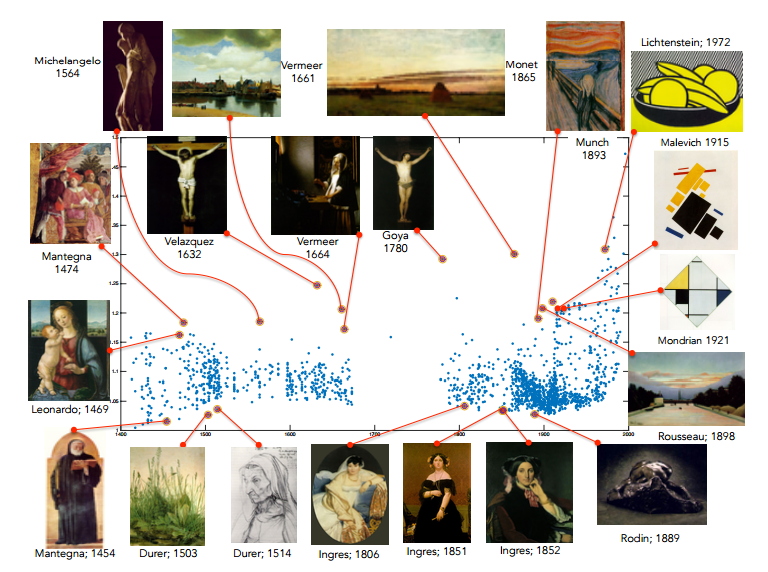
Creativity is one of humanity’s uniquely defining qualities. Numerous thinkers have explored the qualities that creativity must have, and most pick out two important factors: whatever the process of creativity produces, it must be novel and it must be influential.
The history of art is filled with good examples in the form of paintings that are unlike any that have appeared before and that have hugely influenced those that follow. Leonardo’s 1469 Madonna and child with a pomegranate, Goya’s 1780 Christ crucified or Monet’s 1865 Haystacks at Chailly at sunrise and so on. Others paintings are more derivative, showing many similarities with those that have gone before and so are thought of as less creative.
The job of distinguishing the most creative from the others falls to art historians. And it is no easy task. It requires, at the very least, an encyclopedic knowledge of the history of art. The historian must then spot novel features and be able to recognize similar features in future paintings to determine their influence.
Those are tricky tasks for a human and until recently, it would have been unimaginable that a computer could take them on. But today that changes thanks to the work of Ahmed Elgammal and Babak Saleh at Rutgers University in New Jersey, who say they have a machine that can do just this.
They’ve put it to work on a database of some 62,000 pictures of fine art paintings to determine those that are the most creative in history. The results provide a new way to explore the history of art and the role that creativity has played in it