Pages

Thursday, March 27, 2014

PostDoc position (3 years) at Alpen-Adria Universität Klagenfurt, Austria

Institute of Information Technology, Multimedia Communication (MMC) Group (Prof. Hermann Hellwagner)

The MMC group at Klagenfurt University, Austria, is offering a full, three-year PostDoc position (available now) in a basic research project called CONCERT (http://www.concert-project.org/). Important facts about the project are given in the following. We seek candidates with strong expertise in one or several of the following areas: Multimedia Communication, Machine Learning, Multi-Agent Systems, Uncertainty in Artificial Intelligence (Probabilistic Models, Bayesian Networks, Game Theory). Applications should be sent to Prof. Hermann Hellwagner <hermann.hellwagner@aau.at>.

Title: A Context-Adaptive Content Ecosystem Under Uncertainty (CONCERT)
Duration: 3 years
Website: http://www.concert-project.org/

Partners

  • University College London (UK): Prof. George Pavlou, Dr. Wei Chai (Coordinator)
  • University of Surrey (UK): Dr. Ning Wang
  • Ecole Polytechnique Fédérale de Lausanne (CH): Prof. Pascal Frossard
  • Alpen-Adria-Universität (AAU) Klagenfurt (AT): Prof. Hermann Hellwagner

Project character and funding

CONCERT is an international basic research project accepted as a CHIST-ERA project under the Call for Proposals “Context- and Content-Adaptive Communication Networks”. CHIST-ERA is an ERANET consortium, part of the EC FP7 Programme “Future and Emerging Technologies (FET)” (http://www.chistera.eu/). Funding is provided by the national basic research funding agencies, in Austria the FWF (Austrian Science Fund).

Abstract

The objective of CONCERT is to develop a content ecosystem encompassing all rele- vant players which will be able to perform intelligent content and network adaptation in highly dynamic conditions under uncertainty. This ecosystem will have as basis emerging information-/content-centric networking technologies which support in- trinsic in-network content manipulation. The project will consider uncertainty aspects in the following two application domains: (1) social media networks based on user generated content and (2) CDN-like professional content distribution (Content Distri- bution Networks). Three dimensions of uncertainties will be addressed: (1) heteroge- neous and changing service requirements by end users, (2) threats that may have adverse impacts on the content ecosystem, as well as (3) opportunities that can be exploited by specific players in order to have their costs reduced …

[Read More]

Switzerland to host the first Cybathlon, an Olympics for bionic athletes

Article from http://www.theverge.com/2014/3/26/5551180/switzerland-to-host-the-first-cybathlon-an-olympics-for-bionic

A coalition of Swiss robotics labs has announced the Cybathlon, the first-ever international competition for athletes who use prosthetics and other aids, will be held in October of 2016.

The competition is modeled after the Olympics and will feature six events: a bike race, leg race, wheelchair race, exoskeleton race, arm prosthetics race, and Brain Computer Interface race for competitors with full paralysis. The National Centre of Competence in Research (NCCR) Robotics is hosting the competition to spur interest in emerging human-oriented robotics technologies.

Unlike the Olympics, where athletes can use prosthetics only to make themselves as good as able-bodied athletes and not better, Cybathlon competitors are encouraged to use the best technology. Dual prizes will be awarded, one to the athlete and one to the company that created the prosthetic, device, or software.

"The rules of the competition are made in such way that the novel technology will give the pilot an advantage over a pilot that would use a comparable but less advanced or conventional assistive technology," the organization says on its website. "There will be as few technical constraints as possible, in order to encourage the device providers to develop novel and powerful solutions."

Of course, the races will be slower than their Olympic counterparts, but they're also arguably more mind-boggling. The exoskeleton competitors, for example, must walk over a slope, up steps, around pillars, over a see-saw, across a narrow beam, then pick up a bag and carry it, go around tight corners, and then sprint to the finish line.

Tuesday, March 18, 2014

Facebook’s DeepFace Project Nears Human Accuracy In Identifying Faces

Article from: http://techcrunch.com/2014/03/18/faceook-deepface-facial-recognition/

Facebook has reached a major milestone in computer vision and pattern recognition, with ‘DeepFace,’ an algorithm capable of identifying a face in a crowd with 97.25 percent accuracy, which is pretty much on par with how good the average human is (97.5 percent accurate) at recognizing the faces of other walking, talking meat sacks.

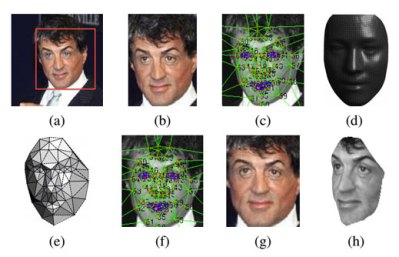
To get past the limitations of ordinary facial matching software, Facebook’s researchers have managed to find a way to build 3D models of faces from a photo, which can then be rotated to provide matching of the same face captured at different angles. In the past, facial recognition via computer could be pretty easily foiled if a subject is simply tilting their head in a slightly different direction.

The Facebook DeepFace algorithm needs to be trained on an extensive pool of faces to be able to perform its magic, but it can identify up to 4,000 identities based on a database of over 4 million separate images in its current version. Theoretically, that could be expanded to cover a much larger swatch with further work, and then be applied to Facebook’s social network itself, which would be very useful if Facebook wanted to automate the process of identifying all your contacts, and performing analytical magic like determining who you’re photographed most frequently with, without the use of manual tagging.

So far, this project is being put forward as mostly an academic pursuit,in a research paper released last week, and the research team behind it will present its findings at the Computer Vision and Pattern Recognition conference in Columbus, Ohio in June. Still, it has tremendous potential for future application, both for Facebook itself and in terms of its ramifications for the field of study as a whole.

Article from: http://techcrunch.com/2014/03/18/faceook-deepface-facial-recognition/

6th International Conference on Social Informatics

The International Conference on Social Informatics (SocInfo) is an interdisciplinary venue that brings together researchers from informatics and social sciences to help fill the gap between the two communities. The goal of the conference is to contribute to the definition and exploration of common methodologies and research goals that encompass the objectives and motivate the two disciplines. The venue welcomes contributions on methods from the social sciences applied to the study of socio-technological systems but also about the application of information technology to the study of complex social processes, and the use of social concepts in the design of information systems.

The conference creates an opportunity for the dissemination of knowledge between the two communities by soliciting presentations of original research papers and experience-based case studies in computer science, sociology, psychology, political science, anthropology, economics, linguistics, artificial intelligence, social network analysis, and other disciplines that can shed light on the open questions in the growing field of computational social science.

The event will also offer tutorials, workshops and keynote talks that will be tailored to address the collaboration between the two research cultures in an era when social interactions are ubiquitous and span offline, online and augmented reality worlds.

Research topics of interest include, but are not limited to:

  • New theories, methods and objectives in computational social science
  • Computational models of social phenomena and social simulation
  • Social behavior modeling
  • Social communities: discovery, evolution, analysis, and applications
  • Dynamics of social collaborative systems
  • Social network analysis and mining
  • Mining social big data
  • Social Influence and social contagion
  • Web mining and its social interpretations
  • Quantifying offline phenomena through online data
  • Rich representations of social ties
  • Security, privacy, trust, reputation, and incentive issues
  • Opinion mining and social media analytics
  • Credibility of online content
  • Algorithms and protocols inspired by human societies
  • Mechanisms for providing fairness in information systems
  • Social choice mechanisms in the e-society
  • Social applications of the semantic Web
  • Social system design and architectures
  • Virtual communities (e.g., open-source, multiplayer gaming, etc.)
  • Impact of technology on socio-economic, security, defense aspects
  • Real-time analysis or visualization of social phenomena and social graphs
  • Socio-economic systems and applications
  • Collective intelligence and social cognition

Original manuscripts should be submitted in English in pdf format to the EasyChair submission system (https://www.easychair.org/conferences/?conf=socinfo2014). They should be formatted according to Springer LNCS paper formatting guidelines (http://www.springer.com/computer/lncs?SGWID=0-164-6-793341-0). The length of the full papers should not exceed 14 pages (excluding references).

As in the previous years, the accepted papers will appear in Springer’s Lecture Note Series in Computer Science but we also allow accepted papers to be presented without publication in the conference proceedings, if the authors choose to do so. Some of the full paper submissions can be accepted as short papers based on the decision of the Program Committee. Best papers will be selected and invited for extended journal publications.

To ensure a thorough and fair review process, this year’s conference will rely on a two-tier review process and will enforce strict review guidelines to provide even higher-quality feedback to authors. To further incentivate good feedback to authors, contributions of best reviewers will be awarded with special mentions.

Important dates

  • Full paper submission: August 8, 2014 (23:59 Hawaii Standard Time)
  • Notification of acceptance: September 19, 2014
  • Submission of final version: October 10, 2014
  • Conference dates: November 10-13, 2014


http://socinfo2014.org/calls/call-for-papers/

Used-Car-Style Marketing Comes to Scholarly Publishing

Article from http://scholarlyoa.com/2014/02/26/used-car-style-marketing-comes-to-scholarly-publishing/

PublishFast Publish Fast

Not the way it’s supposed to work.

We recently learned of a website called PublishFast® that offers to sell quick and easy publishing opportunities for scholarly authors.

The site calls itself a “confidential academic service” and says it will help you “get a VIP treatment from the editors of a selection of top-quality journals which are indexed by Science Citation Index (SCI)*, Social Sciences Citation Index (SSCI)*, Arts and Humanities Citation Index (AHCI)* and Scopus*.”

The journal titles are not divulged on the site. The company also boasts, “PublishFast® is probably the best kept secret among many proliferate researchers in the academic world for years!” [I think they mean prolific, not proliferate].

This statement — plus a chart on the main page — misleads readers into believing that the service started in 2011. In fact, the domain-name registration data suggests a recent UK origin:

Registrant’s address:
First Avenue
Publishers Bldg
Bodmin
CON
PL31 2JX
United Kingdom

Registrar
1 & 1 Internet AG [Tag = SCHLUND]
URL: http://www.1and1.co.uk or http://registrar.1und1.info

Relevant dates:
Registered on: 17-Feb-2014
Expiry date:  17-Feb-2016
Last updated:  17-Feb-2014

Regarding cost, on its FAQ page, PublishFast says it charges $199. But this charge is just for the service. There is likely a separate fee for the APC, the article processing charge, once the paper gets accepted.

I am certain that everyone with a stake in the future of scholarly communication will agree that this site is a corruption of the ideals of scholarship. Let’s all hope it goes away soon.

Article from http://scholarlyoa.com/2014/02/26/used-car-style-marketing-comes-to-scholarly-publishing/

IST2014

Following the success of events in Stresa, Italy 2004, Niagara Falls in Canada 2005, Minori in Italy 2006, Krakow in Poland 2007, Chania in Greece 2008, Shenzhen in China 2009, Thessaloniki in Greece 2010 Penang in Malaysia 2011, Manchester in the UK 2012, and the recent success in Beijing in China 2013, the 2014 IEEE International Conference on Imaging Systems and Techniques (IST 2014) and the IEEE International School of Imaging (ISI) will take place in Santorini Island, Greece.

Engineers, scientists and medical professionals from Industry, Government, Academia, and Medical Laboratories who want to maximize their technical and clinical skills in challenging areas and emerging frontiers of imaging and diagnostic device industry, can attend the IST Conference and the School (ISI) and interact with major worldwide experts.

The IST 2014 Conference and the International School of Imaging are two distinct events, taking place consecutively, and both addressing the following four areas:

MEDICAL DIAGNOSTICS AND THERANOSTICS
  • Clinical diagnostics and theranostics devices and techniques 
  • Miniaturization of diagnostic devices and mass spectroscopy systems 
  • Electroluminescence, bioluminescence, and amplification fluorescence 
  • Biomarkers, proteomics, Imaging genomics, sequencing, and microfluidic chips 
  • Nanoscale materials, polymer nanostructures, nanophotonics, and nanomedicine 
  • Image processing and pattern recognition
SPACE DEFENSE
  • Defense and space surveillance imaging technologies 
  • Advanced space instruments and satellite imaging 
  • Multilayered imaging technologies 
  • Bioinspired Imaging, robotics, guidance and control 
  • Image processing and pattern recognition
MATERIAL INSPECTION AND MANUFACTURING
  • Semiconductor wafers, nanomaterials, composites, and corrosion 
  • Sensors and image acquisition 
  • Illumination architectures 
  • In-line inspection rapid, whole wafer defect detection 
  • Off-line inspection for defect review and failure analysis
  • Techniques for critical dimension (CD) and overlay metrology 
  • Automatic defect classification 
  • Pharmaceutical and food processing vision Inspection Systems 
  • Image processing and pattern recognition
IMAGING MODALITIES
  • Cameras, microscopy and displays 
  • Polarimetry, multispectral imaging 
  • Tomography (CT, SPECT, PET, ECT) 
  • Ultrasound and laser acoustics 
  • Multimodality Imaging 
  • Energy harvesting and imaging technologies 
  • Emerging imaging trends


http://ist2014.ieee-ims.org/