This page is no longer actively maintained; please see my main homepage at: chatzichristofis.info


A drone from the University of Zurich is an engineering and technical marvel. It also moves slower than someone taking a Sunday morning jog.
At the International Conference on Intelligent Robots and Systems in Madrid last October, the autonomous drone, which navigates using artificial intelligence, raced through a complicated series of turns and gates, buzzing and moving like a determined and oversized bumblebee. It bobbed to duck under a bar that swooshed like a clock hand, yawed left, pitched forward and raced toward the finish line. The drone, small and covered in sensors, demolished the competition, blazing through the course twice as fast as its nearest competitor. Its top speed: 5.6 miles per hour.
A few weeks earlier, in Jeddah, Saudi Arabia, a different drone, flown remotely by its pilot, Paul Nurkkala, shot through a gate at the top of a 131-foot-high tower, inverted into a roll and then dove toward the earth. Competitors trailed behind or crashed into pieces along the course, but this one swerved and corkscrewed through two twin arches, hit a straightaway and then blasted into the netting that served as the finish line for the Drone Racing League’s world championship. The winning drone, a league-standard Racer3, reached speeds over 90 miles per hour, but it needed a human to guide it. Mr. Nurkkala, known to fans as Nurk, wore a pair of goggles that beamed him a first-person view of his drone as he flew it.
NVIDIA Research has demonstrated GauGAN, a deep learning model that converts simple doodles into photorealistic images. The tool crafts images nearly instantaneously, and can intelligently adjust elements within images, such as adding reflections to a body of water when trees or mountains are placed near it.
The new tool is made possible using generative adversarial networks called GANs. With GauGAN, users select image elements like 'snow' and 'sky,' then draw lines to segment an image into different elements. The AI automatically generates the appropriate image for that element, such as a cloudy sky, grass, and trees.
As NVIDIA reveals in its demonstration video, GauGAN maintains a realistic image by dynamically adjusting parts of the render to match new elements. For example, transforming a grassy field to a snow-covered landscape will result in an automatic sky change, ensuring the two elements are compatible and realistic.
GauGAN was trained using millions of images of real environments. In addition to generating photorealistic landscapes, the tool allows users to apply style filters, including ones that give the appearance of sunset or a particular painting style. According to NVIDIA, the technology could be used to generate images of other environments, including buildings and people.
Talking about GauGAN is NVIDIA VP of applied deep learning research Bryan Catanzaro, who explained:
This technology is not just stitching together pieces of other images, or cutting and pasting textures. It's actually synthesizing new images, very similar to how an artist would draw something.
NVIDIA envisions a tool based on GauGAN could one day be used by architects and other professionals who need to quickly fill a scene or visualize an environment. Similar technology may one day be offered as a tool in image editing applications, enabling users to add or adjust elements in photos.
The company offers online demos of other AI-based tools on its AI Playground.
The ability of AI to generate fake visuals is not yet mainstream knowledge, but a new website — ThisPersonDoesNotExist.com — offers a quick and persuasive education.
The site is the creation of Philip Wang, a software engineer at Uber, and uses research released last year by chip designer Nvidia to create an endless stream of fake portraits. The algorithm behind it is trained on a huge dataset of real images, then uses a type of neural network known as a generative adversarial network (or GAN) to fabricate new examples.
“Each time you refresh the site, the network will generate a new facial image from scratch,” wrote Wang in a Facebook post. He added in a statement to Motherboard: “Most people do not understand how good AIs will be at synthesizing images in the future.”
The underlying AI framework powering the site was originally invented by a researcher named Ian Goodfellow. Nvidia’s take on the algorithm, named StyleGAN, was made open source recently and has proven to be incredibly flexible. Although this version of the model is trained to generate human faces, it can, in theory, mimic any source. Researchers are already experimenting with other targets. including anime characters, fonts, and graffiti.
The future of work is usually discussed in theoretical terms. Reports and opinion pieces cover the full spectrum of opinion, from the dystopian landscape that leaves millions unemployed, to new opportunities for social and economic mobility that could transform society for the better.
The World Economic Forum’s The Future of Jobs 2018 aims to base this debate on facts rather than speculation. By tracking the acceleration of technological change as it gives rise to new job roles, occupations and industries, the report evaluates the changing contours of work in the Fourth Industrial Revolution.
One of the primary drivers of change identified is the role of emerging technologies, such as artificial intelligence (AI) and automation. The report seeks to shed more light on the role of new technologies in the labour market, and to bring more clarity to the debate about how AI could both create and limit economic opportunity. With 575 million members globally, LinkedIn’s platform provides a unique vantage point into global labour-market developments, enabling us to support the Forum's examination of the trends that will shape the future of work.
Our analysis uncovered two concurrent trends: the continued rise of tech jobs and skills, and, in parallel, a growth in what we call “human-centric” jobs and skills. That is, those that depend on intrinsically human qualities.
Walker is one of newest robots from UBTECH Robotics. Below is just a few of the features and technologies used in its development.
1.Flexible walking on complex terrain: With gait planning and control, Walker can achieve stable walking on different surfaces including carpet, floor, marble, and more. Walker can also adapt to complex environments such as obstacles, slopes, steps, and uneven ground.
2.Self-balancing: When Walker is disturbed by external impact or inertia, it can automatically adjust its center of gravity to maintain balance.
3.Hand-eye coordination: Walker’s hands offer seven degrees of freedom to flexibly manipulate objects. By combining its hands with its own perception, Walker can also position dynamic external objects while adapting to uncertain conditions in real-time.
4.U-SLAM navigation and obstacle avoidance: UBTECH Simultaneous Localization and Mapping (U-SLAM) uses environmental information to avoid obstacles and determine Walker’s best path through a dynamic environment.
5.Face and object recognition: Walker has powerful machine vision capabilities to detect and recognize corresponding faces and objects in complex background environments.
6.Smart home control: Walker can help users control common household equipment such as lighting, electrical appliances and electrical sockets, enhancing safety, convenience, and comfort.
With so much innovative technology packed into its humanoid robot body, Walker has the intelligence and capabilities to make a helpful impact in any home or business in the very near future.
Founded in 2012, UBTECH is a global leading AI and humanoid robotic company. In 2018, UBTECH achieved a valuation of USD$5 billion following the single largest funding round ever for an artificial intelligence company, underscoring the company’s technological leadership.
If you want a versatile robot arm, today’s market really only offers two options: expensive industrial robots, or glorified toys. Low-end models may look similar to “real” robot arms, but they don’t usually have the accuracy or repeatability to do actual work. The new Hexbot, however, is designed to give you the best of both worlds.
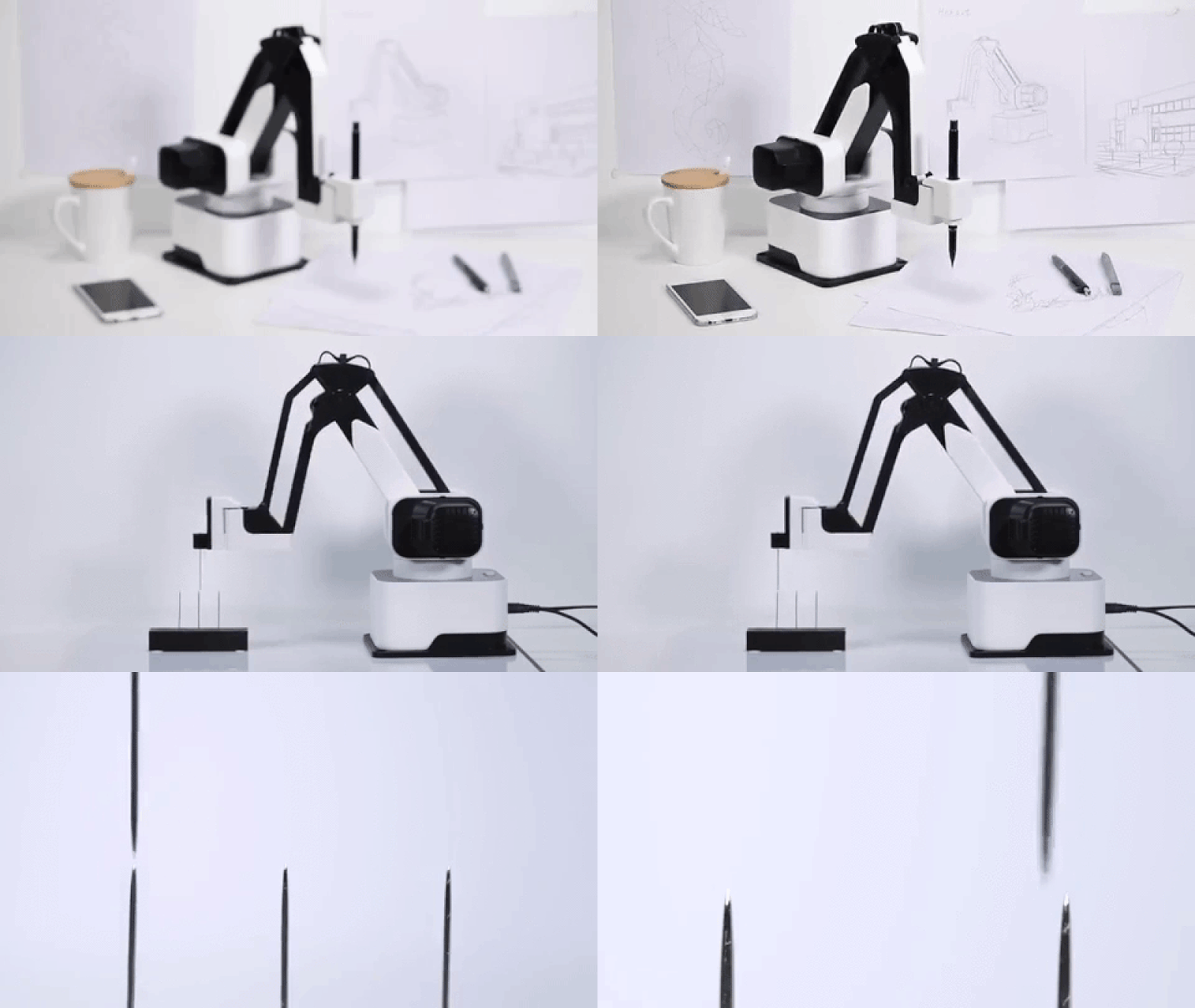
Hexbot just launched on Kickstarter, but has already reached more than three times the $50,000 funding goal. It’s easy to see why; Hexbot is a small, but capable, modular robot arm that costs just $299 through the Kickstarter Special. That price puts it near the bottom of the market, but it has the kinds of features and specs you’d normally only find on mid-level robot arms.
https://blog.hackster.io/finally-a-do-it-all-robot-arm-thats-actually-affordable-df6252e838e6
A team of researchers has stumbled on a question that is mathematically unanswerable because it is linked to logical paradoxes discovered by Austrian mathematician Kurt Gödel in the 1930s that can’t be solved using standard mathematics.
The mathematicians, who were working on a machine-learning problem, show that the question of ‘learnability’ — whether an algorithm can extract a pattern from limited data — is linked to a paradox known as the continuum hypothesis. Gödel showed that the statement cannot be proved either true or false using standard mathematical language. The latest result appeared on 7 January in Nature Machine Intelligence1.
“For us, it was a surprise,” says Amir Yehudayoff at the Technion–Israel Institute of Technology in Haifa, who is a co-author on the paper. He says that although there are a number of technical maths questions that are known to be similarly ‘undecidable’, he did not expect this phenomenon to show up in a relatively simple problem in machine learning.
John Tucker, a computer scientist at Swansea University, UK, says that the paper is “a heavyweight result on the limits of our knowledge”, with foundational implications for both mathematics and machine learning.
This tool introduces machine learning by providing hands-on experiences for training machine learning systems and building things with them.
It provides an easy-to-use guided environment for training machine learning models for classifying text, numbers or recognising images.
This builds on existing efforts to introduce and teach coding to children, by adding these models to Scratch (a widely used educational coding platform), allowing children to create projects and build games with the machine learning models that they've trained.
A useful general home robot, as far as I’m concerned, needs to be able to do three things: fold laundry, wash dishes, and clean toilets. That’s all it would take to make me happy. We’ve seen some attempts at both laundry foldingand washing dishes, but not a lot of bathroom cleaning. Now, thanks to the World Robot Summit (WRS) in Japan, robots are finally tackling this task. As part of a competition held at the event, robots had to clean water from around a toilet and clean trash off the floor. Team Homer at the University of Koblenz-Landau, Germany, managed to get things done with a TIAGo mobile manipulator that you could (almost) picture cleaning up your bathroom as well.
During the competition, judges randomly sprinkled water on and around a toilet. Teams had to clean at least 80 percent of the liquid and remove trash from the floor in order to get full points.
Remove.bg is a free service to remove the background of any photo. It works 100% automatically: You don't have to manually select the background/foreground layers to separate them - just select your image and instantly download the result image with the background removed!

On 12 December the European Commission and partners of the AI4EU project signed a new grant agreement, paving the way for an AI-on-demand platform for Europe. AI4EU will mobilise the whole European AI ecosystem and already unites 79 partners in 21 countries in a network across Europe and will provide access to relevant AI resources in the EU for all users.
Eight industry-driven AI pilots will demonstrate the value of the AI-on-demand platform as a technological innovation tool. The pilots and research will showcase how AI4EU can stimulate scientific discovery and technological innovation. The AI4EU Ethics Observatory will be established to ensure the respect of human centred AI values. Sustainability will be ensured via the creation of the AI4EU Foundation. The results will feed a new and comprehensive Strategic Research Innovation Agenda for Europe.
The AI4EU project, led by THALES, France, receives a total funding of €20 million over the next 3 years. €3 million will be allocated for Financial Support for Third Parties (FSTPs) to fund promising projects (selected through open competitive calls) exploiting the resources and services offered by the platform to foster technology transfer of AI-based solutions.
The Digital Innovation Hubs for robotics will work closely together with the AI-on-demand platform project AI4EU.
On 25th April 2018 the European Commission launched a Communication on artificial intelligence, paving the way towards the development of the AI-on-demand platform. On 7 December 2018 the European Commission presented the coordinated action plan to foster the development and use of AI in Europe prepared together with Member States and Norway and Switzerland who signed the declaration of cooperation on artificial intelligence.
The draft ethics guidelines working document from the #AI_HLEG is online for stakeholders' consultation in the European AI Alliance forum. http://bit.ly/2QDmgmG
Join to make your voice heard http://bit.ly/2l7xw8v

TECH PUNDIT TIM O’Reilly had just tried the new Google Photos app, and he was amazed by the depth of its artificial intelligence.
O’Reilly was standing a few feet from Google CEO and co-founder Larry Page this past May, at a small cocktail reception for the press at the annual Google I/O conference—the centerpiece of the company’s year. Google had unveiled its personal photos app earlier in the day, andO’Reilly marveled that if he typed something like “gravestone” into the search box, the app could find a photo of his uncle’s grave, taken so long ago.
The app uses an increasingly powerful form of artificial intelligence called deep learning. By analyzing thousands of photos of gravestones, this AI technology can learn to identify a gravestone it has never seen before. The same goes for cats and dogs, trees and clouds, flowers and food.
The Google Photos search engine isn’t perfect. But its accuracy is enormously impressive—so impressive that O’Reilly couldn’t understand why Google didn’t sell access to its AI engine via the Internet, cloud-computing style, letting others drive their apps with the same machine learning. That could be Google’s real money-maker, he said. After all, Google also uses this AI engine to recognize spoken words, translate from one language to another, improve Internet search results, and more. The rest of the world could turn this tech towards so many other tasks, from ad targeting to computer security.
Well, this morning, Google took O’Reilly’s idea further than even he expected. It’s not selling access to its deep learning engine. It’s open sourcing that engine, freely sharing the underlying code with the world at large. This software is called TensorFlow, and in literally giving the technology away, Google believes it can accelerate the evolution of AI. Through open source, outsiders can help improve on Google’s technology and, yes, return these improvements back to Google.
Read More - http://www.wired.com/2015/11/google-open-sources-its-artificial-intelligence-engine/?mbid=social_fb