Pages

Thursday, September 10, 2009

IARIA conferences 2010

DigitalWorld 2010
February 10-15, 2010 - St. Maarten, Netherlands Antilles

  • ICDS 2010, The Fourth International Conference on Digital Society
  • ACHI 2010, The Third International Conferences on Advances in Computer-Human Interactions
  • ICQNM 2010, The Fourth International Conference on Quantum, Nano and Micro Technologies
  • GEOProcessing 2010, The Second International Conference on Advanced Geographic Information Systems, Applications, and Services
  • eTELEMED 2010, The Second International Conference on eHealth, Telemedicine, and Social Medicine
    • MLMB 2010: The First International Workshop on Applications of Machine Learning Techniques in Medicine and Biology
    • BUSMMed 2010: The International Workshop on Business Modeling for the Next Generation of Telemedicine Systems and Services
  • eL&mL 2010, The Second International Conference on Mobile, Hybrid, and On-line Learning
  • eKNOW 2010, The Second International Conference on Information, Process, and Knowledge Management
    • WEBONT 2010: The First International Workshop on Ontologies on the Web
  • CYBERLAWS 2010, The First International Conference on Technical and Legal Aspects of the e-Society

InfoSys 2010
March 7-13, 2010 - Cancun, Mexico

  • ICNS 2010, The Sixth International Conference on Networking and Services
    • LMPCNA 2010: The Second International Workshop on Learning Methodologies and Platforms used in the Cisco Networking Academy
  • ICAS 2010, The Sixth International Conference on Autonomic and Autonomous Systems
  • INTENSIVE 2010, The Second International Conference on Resource Intensive Applications and Services

BioSciencesWorld 2010
March 7-13, 2010 - Cancun, Mexico

  • BIOTECHNO 2010 , The Second International Conference on Advances in Biotechnologies
  • BIOINFO 2010 , The First International Conference on Advances in Bioinformatics and Applications
  • BIOSYSCOM 2010 , The First International Conference on Computational and Systems Biology and Microbiology
  • BIOGREEN 2010 , The First International Conference on Advances in Renewable and Sustainable Energies
  • BIODIV 2010 , The First International Conference on Biodiversity and Invasion Control
  • BIOENVIRONMENT 2010 , The First International Conference on Environmental Change Awareness

GlobeNet 2010
April 11-16, 2010 -
Menuires, The Three Valleys, French Alps, France

  • ICN 2010, The Ninth International Conference on Networks
  • ICONS 2010, The Fifth International Conference on Systems
  • DBKDA 2010, The Second International Conference on Advances in Databases, Knowledge, and Data Applications

WebTel 2010
May 9-15, 2010 - Barcelona, Spain

  • AICT 2010 , The Sixth Advanced International Conference on Telecommunications
  • ICIW 2010 , The Fifth International Conference on Internet and Web Applications and Services
  • ICIMP 2010 , The Fifth International Conference on Internet Monitoring and Protection

NexComm 2010
June 13-19, 2010 - Athens, Greece

  • CTRQ 2010, The Third International Conference on Communication Theory, Reliability, and Quality of Service
  • ICDT 2010, The Fifth International Conference on Digital Telecommunications
  • SPACOMM 2010, The Second International Conference on Advances in Satellite and Space Communications
  • MMEDIA 2010, The Second International Conferences on Advances in Multimedia

NetWare 2010
July 18-25, 2010 - Venice, Italy

  • SENSORCOMM 2010 , The Fourth International Conference on Sensor Technologies and Applications
  • SECURWARE 2010 , The Fourth International Conference on Emerging Security Information, Systems and Technologies
  • MESH 2010, The Third International Conference on Advances in Mesh Networks
  • AFIN 2010, The Second International Conference on Advances in Future Internet
  • DEPEND 2010, The Third International Conference on Dependability

InfoWare 2010
September 20-25, 2010 - Valencia, Spain

  • ICCGI 2010, The Fifth International Multi-Conference on Computing in the Global Information Technology
  • ICWMC 2010, The Sixth International Conference on Wireless and Mobile Communications
  • INTERNET 2010, The Second International Conference on Evolving Internet
  • ACCESS 2010, The First International Conferences on Access Networks, Services and Technologies

The Second International Conferences on Advances in Multimedia, MMEDIA 2010

The rapid growth of information on the Web, its ubiquity and pervasiveness makes the www the biggest repository. While the volume of information may be useful, it creates new challenges for information retrieval, identification, understanding, selection, etc. Investigating new forms of platforms, tools, principles offered by Semantic Web opens another door to enable humans programs, or agents to understand what records are about, and allows integration between domain-dependent and media-dependent knowledge. Multimedia information has always been part of the Semantic Web paradigm, but requires substantial effort to integrate both.

The new technological achievements in terms of speed and the quality of expanding and creating a vast variety of multimedia services like voice, email, short messages, Internet access, m-commerce, to mobile video conferencing, streaming video and audio.

Large and specialized databases together with these technological achievements have brought true mobile multimedia experiences to mobile customers. Multimedia imply adoption of new technologies and challenges to operators and infrastructure builders in terms of ensuring fast and reliable services for improving the quality of web information retrieval.

Huge amounts of multimedia data are increasingly available. The knowledge of spatial and/or temporal phenomena becomes critical for many applications, which requires techniques for the processing, analysis, search, mining, and management of multimedia data.

MMEDIA 2010 aims to provide an international forum by researchers, students, and professionals for presenting recent research results on advances in multimedia, mobile and ubiquitous multimedia and to bring together experts from both academia and industry for the exchange of ideas and discussion on future challenges in multimedia fundamentals, mobile and ubiquitous multimedia, multimedia ontology, multimedia user-centered perception, multimedia services and applications, and mobile multimedia.

The topics suggested by the conference can be discussed in term of concepts, state of the art, research, standards, implementations, running experiments, applications, and industrial case studies. Authors are invited to submit complete unpublished papers, which are not under review in any other conference or journal in the following, but not limited to, topic areas.  All tracks are open to both research and industry contributions.

http://www.iaria.org/conferences2010/CfPMMEDIA10.html

Experimental content based retrieval engine which operates within a real time 3D virtual reality environment.

This system presents the idea of content based retrieval of 3D models within a VR environment. A 3D reconstruction of a part of the old city of Xanthi has been used as a test-bed 3D scene. Within this environment the user can perform a virtual walkthrough and by clicking on objects the system performs aquery-by-example to a database and retrieves the coordinates of similar objects that might exist within the 3D scene. Animated arrows are then presented over similar objects while the user can monitor on the top map the similarity ranking of the retrieved objects.
At the moment the system uses our 3D descriptors which are designed for vessels and generally surfaces of revolution and thus the available objects are limited to bottles, flower-pots,etc. With the use of other 3D shape descriptors the system can be expanded for other types of objects such as architectural structures, facade features, etc.
It should be mentioned that the 3D scene is manually segmented into separated 3D model entities which properties such as their digital shape signatures (descriptors), their coordinates within the 3D space and other information are encoded into metadata within a native XML database and when the 3D scene is loaded those are loaded progressively and located to their positions according to their metadata.More specifically a left click on an object initiates a query-by-example call which forwards the object's id to the database. The database compares the digital signatures of the query-object against all other scene objects using a similarity metric and returns a sorted (based-on-shape similarity) list with the id's of the similar objects.The system is based on PHP technology and on the native XML database eXist. The 3D reconstruction of a part of the old city of Xanthi has been modelled using Blender and the web based virtual walkthrough is based on Quest 3D technology which works on IE web browser.
To enter the 3D scene using an IE browser click on the following link Take me to the old city of Xanthi (pop up window) or you can watch a small video demo on youtube.

Additional material related to this project can be found at the following links

3D Reconstruction of the old city of Xanthi
On 3D Reconstruction of the old city of Xanthi (Journal of Cultural Heritage)
Process Evaluation of 3D Reconstruction methodologies targeted to web based VR (CIPA 2007)
Experimental 3D Pottery Content Based Retrieval Engine

Monday, September 7, 2009

Hobby built car-like robot

Article from http://www.aforgenet.com/articles/qwerk_robot_car/

Introduction

It has passed a while since the time I got interested in robotics and started building some stuff. Initially, as many other novice hobbyists do, I started with something simple and tried different Lego Mindstorms Robotics kits, like RCX and NXT. These kits are really easy to start with and allow building many different things, like car-bots, pan-tilt cameras, etc. But eventually you may want trying something more sophisticated, which could result in a robot with wider range of features. To get most flexibility and also enjoy building robots on your own, it is much more preferred to switch from kits like Lego, to some more specialized hardware, like different motors, servos, sensors, controllers, robotics boards, etc. Of course it will not be that easy as with plug-n-play Lego kits, but it may allow us designing our own robot putting the hardware we want for tasks we need. Going this road we need to be a bit prepared and get some simple tools like screwdrivers, soldering tools, wire-cutters, maybe a small saw, files, etc. It may end up in real building, which is real fun!

One of the easy things to use for building your custom robots is a range of different controllers and interface boards provided by Phidgets. These are very nice things which can be plugged into computer's USB port and programmed very easily with SDK provided by the company. Last time I've tried Phidgets for building pan-tilt module for a simple stereo vision setup. This worked really nice and I definitely consider building more on their base. But this time I was interested in building mobile robot and I did not want making PC (even a tiny notebook like EeePC) part of my robot. Instead of this I wanted to get something, which is not so big in size and could be controlled over Wi-Fi. In order to achieve this goal, I made my choice in using Qwerk.

I was already writing about Qwerk board in the past and the way to control it remotely. This is really nice peace of manufacturing, which allows building quite sophisticated robots carrying bunch of sensors, servos, motors, etc. This time it will be used for building mobile robot controlled remotely over Wi-Fi.

What are we going to build ?

This time we are going to build a remotely controlled car robot, with the next list of features:

  • 3 wheels - 2 in the front and 1 one rear. The two wheels in the front will be motorized and will direct robot's movement. Setting equal speed to both motors will result in straight forward/backward movement, but setting different speeds will lead to going left or right.
  • On board camera, which will give a view to the person controlling the robot. In the future the camera may be used also for automated robot's controlling with the help of developed computer vision algorithm.
  • To mimic real cars, the car robot will have some lights - stop lights, turn lights and dimension lights.
  • It will carry some sensors on board, which may be used as for fun, as for future tasks targeted to autonomous movement.
  • And finally to make it wireless, it will have its own battery on board and a Wi-Fi communication module.

It should be really nice, when all the above is done and works!

Let's start building

The base

One of the fun things in building something as a hobby is building everything on your own using all sort of stuff you can find around and can make use of. For example, building a robot you may find that different stuff left after flat repairing will work fine, as well as old broken child's toys, electronics, etc. Sometimes it may be hard to find a specialized part for the robot you build or it may be not that cheap buying dedicated stuff out of a set. So, building a robot I always take a look around the flat for something, which may become useful.

This time it happened with robot's base. I was looking for something, which could be used to attach wheels to and carry all the robot's stuff. And I found that a small cutting board looks so nice as a robot's base ... Yes, sounds crazy - cutting board used in robotics. But I could not resist when I found that accidentally in a regular shop and imagined my robot with it.

Read More

The SpringerImages Collection

Introducing Springer’s comprehensive collection of scientific and medical images

Scientific research has become progressively more focused on raw data and visual forms of learning and communication. These visuals come in many different forms, ranging from charts and graphs to high-quality photos. SpringerImages spans science, technology and medicine in 18 subject collections with over 1.5 million photos, graphs, histograms, tables and more.
Now end users can search images faster and easier than ever before.

Searching for specific images? No more screening long texts! SpringerImages spans science, technology and medicine with over 1.5 million photos, graphs, histograms, tables and more. Features include a powerful search interface and download privileges.

Features

• Over 1.5 million scientific, technical and medical images online
• Rapidly growing collection as images are added as they are published
• Based on trusted sources, such as SpringerLink or images.MD

SEARCH NOW at SpringerImages.com !

Librarian Benefits

Help increase the productivity of their researchers, as they spend less time reviewing the literature
Be confident that they always offer the most up-to-date data
Be sure that they offer high-quality data from a trusted source
Increase exposure to other content and maximize the investment in SpringerImages
Support their researchers in finding images more easily and getting answers faster – 24 hours a day
Monitor user behavior to see the results of their investment immediately

Researcher Benefits
Get a refined and relevant list of results quickly when searching for pertinent pieces of information in a vast quantity

Easily jump to the source to confirm the context and retrieve further information
Quickly understand the context of an image, dramatically reducing the time needed to review literature
You can always rely on up-to-date data and research results on SpringerImages, because images are automatically updated as content is published
Use images to quickly update lectures or presentations
Easily customize the search to your individual needs, such as comparison of research results or sharing keywords with other users to optimize the search

Covering all STM Subjects

Biomedicine .................... Chemistry ....................... Computer Science
Economics / Management Sciences ..................... Education
Engineering ..................... Environment .................. Geography
Geosciences ................... Humanities / Arts .......... Life Sciences
Material Science ............. Mathematics .................. Medicine & Public Health
Pharmacy ......................... Physics ........................... Psychology
Social Sciences

Availability

There are two options for subscribing to SpringerImages. You may subscribe to the entire collection of SpringerImages or to the Medical and Life Sciences collection only.

http://www.springerimages.com/

Sunday, September 6, 2009

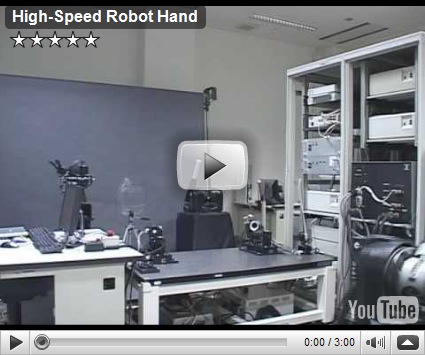
High-Speed Robot Hand

Ishikawa Komuro Lab's high-speed robot hand performing impressive acts of dexterity and skillful manipulation
http://www.k2.t.u-tokyo.ac.jp/papers/fusion_movies-e.html