Pages

Wednesday, October 26, 2011

Nano-spring make transparent, super-stretchy skin-like sensors

Article from:

 http://www.sciencecodex.com/read/stanford_researchers_build_transparent_superstretchy_skinlike_sensor-80227

article-0-0E85B7F000000578-63_468x260

When the nanotubes are airbrushed onto the silicone, they tend to land in randomly oriented little clumps. When the silicone is stretched, some of the "nano-bundles" get pulled into alignment in the direction of the stretching.

When the silicone is released, it rebounds back to its original dimensions, but the nanotubes buckle and form little nanostructures that look like springs.

"After we have done this kind of pre-stretching to the nanotubes, they behave like springs and can be stretched again and again, without any permanent change in shape," Bao said.

Stretching the nanotube-coated silicone a second time, in the direction perpendicular to the first direction, causes some of the other nanotube bundles to align in the second direction. That makes the sensor completely stretchable in all directions, with total rebounding afterward.

Additionally, after the initial stretching to produce the "nano-springs," repeated stretching below the length of the initial stretch does not change the electrical conductivity significantly, Bao said. Maintaining the same conductivity in both the stretched and unstretched forms is important because the sensors detect and measure the force being applied to them through these spring-like nanostructures, which serve as electrodes.

The sensors consist of two layers of the nanotube-coated silicone, oriented so that the coatings are face-to-face, with a layer of a more easily deformed type of silicone between them.

The middle layer of silicone stores electrical charge, much like a battery. When pressure is exerted on the sensor, the middle layer of silicone compresses, which alters the amount of electrical charge it can store. That change is detected by the two films of carbon nanotubes, which act like the positive and negative terminals on a typical automobile or flashlight battery.

The change sensed by the nanotube films is what enables the sensor to transmit what it is "feeling." Whether the sensor is being compressed or extended, the two nanofilms are brought closer together, which seems like it might make it difficult to detect which type of deformation is happening. But Lipomi said it should be possible to detect the difference by the pattern of pressure.

Using carbon nanotubes bent to act as springs, Stanford researchers have developed a stretchable, transparent skin-like sensor. The sensor can be stretched to more than twice its original length and bounce back perfectly to its original shape. It can sense pressure from a firm pinch to thousands of pounds. The sensor could have applications in prosthetic limbs, robotics and touch-sensitive computer displays. Darren Lipomi, a postdoctoral researcher in Chemical Engineering and Zhenan Bao, associate professor in Chemical Engineering, explain their work.

(Photo Credit: Steve Fyffe, Stanford News Service)

With compression, you would expect to see sort of a bull's-eye pattern, with the greatest deformation at the center and decreasing deformation as you go farther from the center.

"If the device was gripped by two opposing pincers and stretched, the greatest deformation would be along the straight line between the two pincers," Lipomi said. Deformation would decrease as you moved farther away from the line.

Bao's research group previously created a sensor so sensitive to pressure that it could detect pressures "well below the pressure exerted by a 20 milligram bluebottle fly carcass" that the researchers tested it with. This latest sensor is not quite that sensitive, she said, but that is because the researchers were focused on making it stretchable and transparent.

"We did not spend very much time trying to optimize the sensitivity aspect on this sensor," Bao said.

"But the previous concept can be applied here. We just need to make some modifications to the surface of the electrode so that we can have that same sensitivity."

Article from:

 http://www.sciencecodex.com/read/stanford_researchers_build_transparent_superstretchy_skinlike_sensor-80227

Artificial intelligence community mourns John McCarthy

Article from http://www.bbc.co.uk/news/technology-15444222

John McCarthyArtificial intelligence researcher, John McCarthy, has died. He was 84.
The American scientist invented the computer language LISP.

It went on to become the programming language of choice for the AI community, and is still used today.

Professor McCarthy is also credited with coining the term "Artificial Intelligence" in 1955 when he detailed plans for the first Dartmouth conference. The brainstorming sessions helped focus early AI research.

Prof McCarthy's proposal for the event put forward the idea that "every aspect of learning or any other feature of intelligence can in principle be so precisely described that a machine can be made to simulate it".

The conference, which took place in the summer of 1956, brought together experts in language, sensory input, learning machines and other fields to discuss the potential of information technology.

Other AI experts describe it as a critical moment.

"John McCarthy was foundational in the creation of the discipline Artificial Intelligence," said Noel Sharkey, Professor of Artificial Intelligence at the University of Sheffield.

"His contribution in naming the subject and organising the Dartmouth conference still resonates today."

LISP

Prof McCarthy devised LISP at Massachusetts Institute of Technology (MIT), which he detailed in an influential paper in 1960.

The computer language used symbolic expressions, rather than numbers, and was widely adopted by other researchers because it gave them the ability to be more creative.

"The invention of LISP was a landmark in AI, enabling AI programs to be easily read for the first time," said Prof David Bree, from the Turin-based Institute for Scientific Interchange.

"It remained the AI language, especially in North America, for many years and had no major competitor until Edinburgh developed Prolog."

Regrets

In 1971 Prof McCarthy was awarded the Turing Award from the Association for Computing Machinery in recognition of his importance to the field.

He later admitted that the lecture he gave to mark the occasion was "over-ambitious", and he was unhappy with the way he had set out his new ideas about how commonsense knowledge could be coded into computer programs.

However, he revisted the topic in later lectures and went on to win the National Medal of Science in 1991.

After retiring in 2000, Prof McCarthy remained Professor Emeritus of Computer Science at Stanford University, and maintained a websitewhere he gathered his ideas about the future of robots, the sustainability of human progress and some of his science fiction writing.

"John McCarthy's main contribution to AI was his founding of the field of knowledge representation and reasoning, which was the main focus of his research over the last 50 years," said Prof Sharkey

"He believed that this was the best approach to developing intelligent machines and was disappointed by the way the field seemed to have turned into high speed search on very large databases."

Prof Sharkey added that Prof McCarthy wished he had called the discipline Computational Intelligence, rather than AI. However, he said he recognised his choice had probably attracted more people to the subject.

Article from http://www.bbc.co.uk/news/technology-15444222

Tuesday, October 25, 2011

Throwable Camera Creates 360-Degree Panoramic Images

Article from http://mashable.com/2011/10/25/throwable-ball-camera/

Are you, like so many others, tired of all those old-fashioned cameras you have to hold in order to take pictures? Well here’s a camera you get to throw.

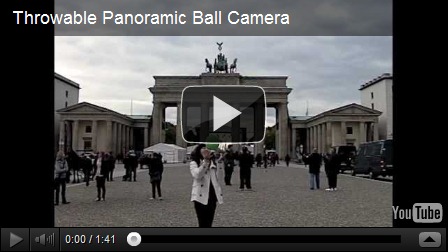
The Throwable Panoramic Ball Camera is a foam-padded ball studded with 36 fixed-focus, 2-megapixel mobile phone camera modules capable of taking a 360-degree panoramic photo.

You use the camera by throwing it directly in the air. When the camera reaches the apex — measured by an accelerometer in the camera — all 36 cameras automatically take a picture. These distinct pictures are then digitally stitched together and uploaded via USB where they are presented in a spherical panoramic viewer. This lets users interactively explore their photos including a zoom function.


SEE ALSO: The Development of the Camera: From Ancient to Instant [INFOGRAPHIC]

The results — as seen in the video above — are pretty darn impressive, but the Ball Camera is definitely not meant for shaky hands. Any spin on the ball when it’s thrown could distort the final image and you certainly wouldn’t want to drop the thing despite its 3D-printed foam padding. The 2-megapixel cameras are adequate but the quality drops as soon as users try to zoom in on distant elements. Besides, it looks a little difficult to fit the thing into a purse, let alone your pocket.

Right now, the Throwable Panoramic Ball Camera is not available to buy, though its creators have it pending a patent. Cool idea, but is it practical? Would you ever buy a camera you could throw? Let us know in the comments.

http://mashable.com/2011/10/25/throwable-ball-camera/

Monday, October 24, 2011

Rendering Synthetic Objects into Legacy Photographs

Kevin Karsch, Varsha Hedau, David Forsyth, Derek Hoiem
To be presented at SIGGRAPH Asia 2011

Abstract

We propose a method to realistically insert synthetic objects into existing photographs without requiring access to the scene or any additional scene measurements. With a single image and a small amount of annotation, our method creates a physical model of the scene that is suitable for realistically rendering synthetic objects with diffuse, specular, and even glowing materials while accounting for lighting interactions between the objects and the scene. We demonstrate in a user study that synthetic images produced by our method are confusable with real scenes, even for people who believe they are good at telling the difference. Further, our study shows that our method is competitive with other insertion methods while requiring less scene information. We also collected new illumination and reflectance datasets; renderings produced by our system compare well to ground truth. Our system has applications in the movie and gaming industry, as well as home decorating and user content creation, among others.

http://kevinkarsch.com/publications/sa11.html

Top 10 ACM SIGMM Downloads

http://sigmm.org/records/records1103/featured04.html

Here we present the top downloaded ACM SIGMM articles from the ACM Digital Library, from July 2010 to June 2011. We are hoping that this list gives a much deserved exposure to the ACM SIGMM's best articles.

  1. Guo-Jun Qi, Xian-Sheng Hua, Yong Rui, Jinhui Tang, Tao Mei, Meng Wang, Hong-Jiang Zhang. Correlative multilabel video annotation with temporal kernels. In ACM Trans. Multimedia Comput. Commun. Appl. 5(1), 2008
  2. Michael S. Lew, Nicu Sebe, Chabane Djeraba, and Ramesh Jain. Content-based multimedia information retrieval: State of the art and challenges. In ACM Trans. Multimedia Comput. Commun. Appl. 2(1), 2006
  3. Ba Tu Truong, Svetha Venkatesh. Video abstraction: A systematic review and classification. In ACM Trans. Multimedia Comput. Commun. Appl. 3(1), 2007
  4. Yu-Fei Ma, Hong-Jiang Zhang. Contrast-based image attention analysis by using fuzzy growing. In ACM Multimedia 2003
  5. Simon Tong and Edward Chang. Support vector machine active learning for image retrieval. In ACM Multimedia 2001
  6. J.-P. Courtiat, R. Cruz de Oliveira, L. F. Rust da Costa Carmo. Towards a new multimedia synchronization mechanism and its formal definition. In ACM Multimedia 1994
  7. Gabriel Takacs, Vijay Chandrasekhar, Natasha Gelfand, Yingen Xiong, Wei-Chao Chen, Thanos Bismpigiannis, Radek Grzeszczuk, Kari Pulli, Bernd Girod. Outdoors augmented reality on mobile phone using loxel-based visual feature organization. In ACM SIGMM MIR 2008
  8. Jiajun Bu, Shulong Tan, Chun Chen, Can Wang, Hao Wu, Lijun Zhang, Xiaofei He. Music recommendation by unified hypergraph: combining social media information and music content. In ACM Multimedia 2010
  9. Mathias Lux, Savvas A. Chatzichristofis. Lire: lucene image retrieval: an extensible java CBIR library. In ACM Multimedia 2008

Thursday, October 20, 2011

FaceLight – Silverlight 4 Real-Time Face Detection

This article describes the simple facial recognition method that searches for a certain sized skin color region in a webcam snapshot. This technique is not as perfect as a professional computer vision library like OpenCV and the Haar-like features they use, but it runs in real time and works for most webcam scenarios.